Customer Relationship Management (CRM) systems have become a mainstay of modern sales teams. They promise clarity, efficiency, and insights that drive revenue. But here’s the uncomfortable truth: your CRM is probably lying to you.
Despite forming the very foundation of your team’s day-to-day activities, most CRM data is inaccurate or incomplete. In fact, studies show that up to 30% of CRM data becomes outdated every year. Imagine a GPS that gave you the wrong directions 3 times out of 10! If you’re wondering why you keep getting lost, your own tools could be sabotaging you.
Crunching the Wrong Numbers
What you put into your CRM determines what you get out of it. In a typical business, there’s likely anywhere from a few SDRs to a few dozen gathering leads, updating accounts, and logging data into your CRM. The only issue is that with so much manual work, you open the door for data entry mistakes, typos, and formatting errors to creep in, especially when speed is prioritized over accuracy. While it’s tempting to chock this up to sloppy attention to detail, when you’re adding data for hundreds of accounts every day, it’s only human to slip up here and there. Most of us just hope it’s not a missing zero at the end of a price quote.
You might consider data imports from a lead gen platform, an automated process, as a means to minimize the chances of human error. While it does lessen the chance of error on the part of your reps, it introduces its own series of issues. When importing leads en masse into your CRM, you run the risk of duplicates or incomplete records creeping in. Not to mention keeping CRM and lead gen data in agreement is a never-ending battle. Suppose you rely on ZoomInfo for lead generation, and export what appears to be a complete list of prospects matching your search criteria. However, the moment ZoomInfo updates its database, your previous import is already outdated. In a perfect world, two-way sync between 3rd party lead gen platforms and CRMs would be commonplace, but in reality, it’s costly and complex. Most organizations would rather bite the bullet of bad data than open the can of worms that comes with resolving it.
Similarly, people change jobs, emails, and phone numbers constantly. What was accurate six months ago may now be useless. This kind of “data decay” is inevitable, but it doesn’t mean we should sit idle and do nothing about it. Unfortunately, without clear ownership or processes for data quality, bad data spreads unchecked.
False Facts, Real Consequences
The true cost of faulty data often goes unseen, but that doesn’t mean you aren’t still suffering from its effects. Missed revenue opportunities pile up when outdated intel kills your ability to personalize your pitch on a call. After all, calling an account and trying to confirm false data is like trying to nail a job interview without knowing the position you’re interviewing for. Not to mention, your team could burn hours chasing dead leads. Imagine you've been nurturing your dream account, checking every box on the way to a million-dollar deal. You’re already thinking of how you’ll spend the commission check and then reality hits—the account corrects your numbers to reveal the deal is barely worth pocket change. It’s a tragic fate for any sales rep to endure, but businesses are experiencing this first-hand to varying degrees.
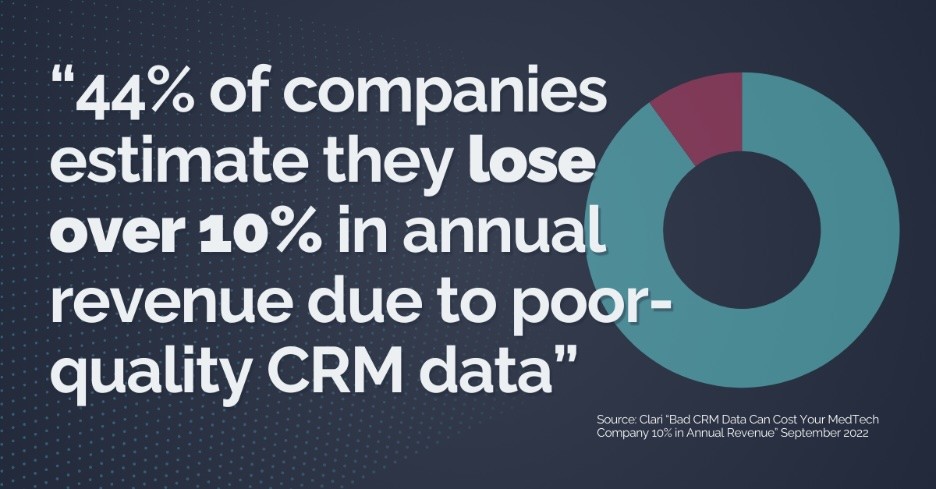
“44% of companies estimate they lose over 10% in annual revenue due to poor-quality CRM data”
Keeping CRM Data Clean and Reliable
A surefire way to reduce human error in your CRM data is to use a CRM with data validation rules. These rules establish how account data can be entered, from mandatory fields and proper formatting, to duplicate detection and error messages. If you break a rule, the system prevents you from proceeding, building in a codified way to minimize incomplete data. As for inaccuracies, you can automate data upkeep through workflows that regularly verify account details, ensuring your records stay fresh.
Enter CapOptix — the all-in-one sales guidance platform. As a sales enablement tool, it sits on top of your CRM and receives updates via two-way sync, which is fully configured and maintained by the CapOptix professional services team. However, unlike a CRM, CapOptix has an in-depth view of every account’s journey through a standardized sales process. Consequently, it can tell you when an account has stagnated in the sales process and automatically schedules an ideal time to revisit it to update the account details. This follow-up system minimizes the risk of data decay by ensuring regular checkups when they matter most.
Keeping the Power of Data on Your Side
Your CRM should be a trusted ally, not a broken compass. The risks of bad data are real, but so are the benefits of fixing it. If you’re interested in learning more about how CapOptix is leading the fight against bad data, contact us to learn more today!
Sources:
https://www.actian.com/blog/data-management/the-costly-consequences-of-poor-data-quality/
https://crmcopilot.ai/common-crm-data-issues-and-how-to-fix-them/