
Sales teams are surrounded by data. Calls are recorded, emails are logged, meetings are tracked, and CRMs are full of fields. Yet many revenue leaders still leave forecast sessions feeling uneasy. They know what happened, but not why it happened or what will happen next.
That tension explains why revenue intelligence has become such a hot topic. It promises clarity. Not more reports, but a clearer understanding of what is actually going on inside deals while there is still time to influence the outcome.
What Revenue Intelligence Actually Means
Revenue intelligence is the practice of capturing selling activity and analyzing it to explain revenue outcomes. It connects what reps do, what buyers say, and how deals move through the pipeline into a single picture.
Most revenue intelligence platforms share these common foundations:
Conversation intelligence
Automatic recording and analysis of calls and meetings to detect risks and best practicesDeal and pipeline insights
Early visibility into stalled deals, missing stakeholders, and unclear next stepsRep execution insights
Clear behaviour patterns that separate top performers from the rest of the teamForecast visibility
Forecasts grounded in real activity and buyer behavior
Revenue Intelligence vs. Sales Enablement
Revenue intelligence is often confused with sales enablement, but they solve different problems.
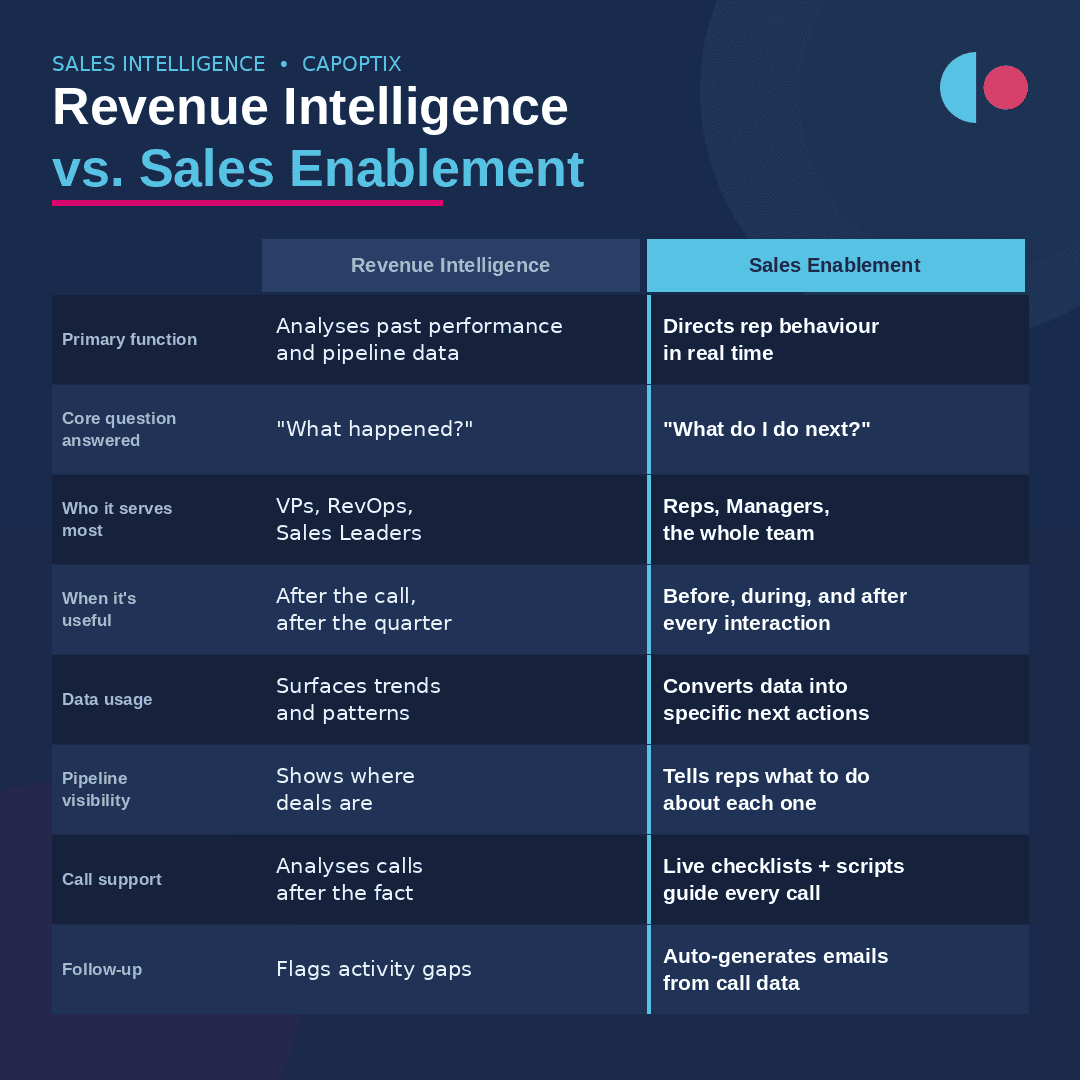
Sales enablement focuses on preparation. It equips reps with training, messaging, playbooks, and content. Revenue intelligence focuses on reality. It analyzes what actually happens when reps talk to buyers and manage opportunities.
For example, enablement may launch a new pricing deck. Revenue intelligence shows whether pricing comes up earlier in conversations, how buyers respond, and whether those deals close faster or stall. Together, the two create a feedback loop between strategy and execution.
Revenue Intelligence Features in CapOptix
As a sales guidance system, CapOptix marries the best of both intelligence and enablement platforms. In a nutshell, it takes the data-driven insights of revenue intelligence and uses them to enable your best on-call practices as a sales executive. Here are two key CapOptix revenue intelligence features:
AI Call Analysis: Turning Conversations into Coaching Signals
CapOptix uses AI Call Analysis to listen across calls and surface what actually matters.
With AI Call Analysis, teams can:
Automatically analyze calls for key moments like pricing discussions, objections, and next steps
Understand script adherence, politeness, and call dynamics
Identify themes across winning and stalled deals
Highlight coaching opportunities without managers needing to review every call
Reporting Dashboards Built for Revenue Decisions
CapOptix reporting dashboards are designed for action, not vanity metrics. Instead of overwhelming teams with charts, dashboards are organized around three revenue-driving dimensions: Quality, Volume, and Velocity.
Quality Metrics focus on how well deals are being executed:
Deal health and consistency of next steps
Buyer engagement and conversation quality
Prospect alignment to ICP
Volume Metrics show whether enough activity exists to hit the target:
Calls, meetings, and opportunities created
Pipeline quota attainment per rep
Outbound activity trends over time
Velocity Metrics reveal how fast revenue is moving:
Time spent in each stage
Deal progression and stall points
Sales cycle trends across teams
Conclusion: From Activity to Understanding
Revenue intelligence is the brain behind all growing sales operations. It helps teams understand why deals move, why they stall, and what to change next. Even if these insights only amount to small changes in strategy, those minor changes in execution can add millions in revenue when scaled across an entire organization.
To learn more about how CapOptix embodies the best of revenue intelligence, visit CapOptix.com.
References
Gartner. (2024). Market Guide for Revenue Intelligence. https://www.gartner.com/en/documents/5579027
Activated Scale. (2026). What is revenue intelligence? Definition, examples, and tools. https://www.activatedscale.com/blog/guide-revenue-intelligence
SalesTech Star. (2026). New Clari Labs research reveals 87% of enterprises missed revenue targets. https://salestechstar.com/predictive-ai-artificial-intelligence/new-clari-labs-research-reveals-87-of-enterprises-missed-revenue-targets-in-2025-despite-record-ai-investment/