
Sales have evolved dramatically over the past few years. From handwritten notes to automated workflows, the industry has always sought efficiency. Today, artificial intelligence is redefining this space with tools that allow sales reps to work smarter, not harder. A staggering 81% of sales teams are either experimenting with AI or have fully implemented it into their workflows. And that’s not all. The global AI market will reach $298 billion in 2025, driven by generative AI and enterprise adoption. This widespread integration of AI marks the beginning of a new era in sales.
The Dawn of an AI-Driven Calling
Before the advent of AI, sales software helped optimize sales processes through technology. CRM reminders, automated call logging and recording, and scheduled email sequences were already helping reps eliminate repetitive tasks. However, while CRMs may have been groundbreaking decades ago, they have now grown infamous for boring data entry through clunky interfaces, adding needless complexity to a sales rep’s busy workday. Sales reps aren’t data entry clerks. They should be on the frontlines doing what they do best.
Although outdated, CRMs were the beginning of reps optimizing their workflows with technology, a monumental step that set the stage for more advanced, AI-powered capabilities to reshape the sales space in due time. Now, we stand at the precipice of an AI-driven sales world. Let’s take a look at the variety of ways AI is shaking up the day-to-day responsibilities of sales teams.
How is AI Used in Calls?
AI is transforming sales calls in lots of exciting ways. For example, vocal analysis tools, which evaluate tone, pace, and emotional cues during calls, help reps gauge buyer sentiment and adjust their approach accordingly.
Tools that incorporate vocal analysis are known as “conversation intelligence” platforms. For example, Gong provides conversational intelligence and also measures talk ratios.
Specifically, anytime a rep boots up a call, Gong measures:
Rep talk time
Total call length
Talk ratio is the percentage of time sales rep are talking rather than listening, a telling metric with a very specific sweet spot. According to Gong’s research, top-performing reps listen more than they talk, usually talking around 47% of the time. Talking too much—especially over ~65%-was linked to lower win rates. These kinds of AI-powered insights are letting reps improve based on call analytics.
Another way AI is transforming sales calls is through real-time coaching, an advanced feature that provides logical talking points and swift objection-handling right when you need it. These insights can also help managers provide more effective coaching. Similarly, AI evaluates how closely reps follow call scripts, ensuring messaging stays on-brand without missing a key topic needed for the call objectives. Post-call analytics can reveal which topics consume excessive time, enabling teams to optimize call structures and improve efficiency. AI can also provide word-for-word transcriptions and high-level summaries, eliminating the need for manual notetaking.
While sales tools have advertised call summaries before, the AI game changer is semantic understanding rather than the outdated method of keyword detection. Keyword detection relies on a predefined list of words. For instance, let’s say your call analysis system is trained to detect the word “disagree”. So, if your prospect says, “I don’t disagree with you” on a call, keyword detection picks up on the word “disagree” and starts sounding alarm bells. Semantic analysis takes into consideration the larger context and nuances of a conversation, allowing it to correctly parse the meaning of a statement like “I don’t disagree.” This results in more accuracy and richness in generated content and insights.
Finally, full AI-CRM integration allows you to automate call follow-up tasks, like status updates and logging calls—a favourite feature of sales reps tired of CRM data cleanup duty. Apollo, with its call-to-CRM quick sync feature, is leading the pack in conversation intelligence in this regard. They leverage AI’s ability to generate insights and extract information from semantic understanding to analyze call recordings and create “conversation objects”. Each object acts as a singular, structured piece of information, like the identity of a decision-maker, a budget range, or even commitments spoken by call participants. After your call, Apollo asks you to map the conversation object to relevant fields in your CRM. Apollo writes to Salesforce, HubSpot, Pipedrive and supports mapping to standard fields, custom fields, and even opportunity-specific fields. The last step is a quick manual review before pushing the changes to your CRM. This manual step is a critical safety net for the integrity of your CRM data. Giving a quick once-over to the updates reduces the likelihood of misheard numbers, sync errors due to mismatched data types, and other edge cases.
How is AI Used in Predictive Analytics?
AI goes hand-in-hand with predictive analytics by enabling teams to forecast outcomes with laser precision. By analyzing historical data, pipeline activity, buyer behavior patterns, and engagement signals, AI can surface trends that help you understand which deals are most likely to close and where risks may be emerging.
In the old days, deal prediction felt more like fortune telling. A sales rep or manager might notice a deal feels “stuck”. At best, your sales tech could automatically flag opportunities based on static rules like noting when a close date is overdue. Nowadays, AI-integrated sales intelligence platforms are not only vastly more conscious of deal health indicators from both the buyer’s side and seller’s side, but CRMs can now fine-tune their risk detection algorithm with breakthroughs in machine learning.
Machine learning is more than just a fancy buzzword for investors. In the exciting world of artificial intelligence, machine learning refers to computer systems that operate based on patterns learned from data, rather than a ruleset defined by a programmer. For example, a traditional deal flagging system might write instructions like this:
“If no meeting in 14 days, then mark the deal as at risk.”
Machine learning isn’t so rigid. You give the system a large amount of historical examples, such as thousands of deals with varying outcomes, and the system designs its own set of adjustable, data-driven rules. A machine learning system might write something more like:
“If no meeting in X days, mark the deal as at risk.”
Here, X is constantly being recalibrated based on your own unique sales experiences to find the ideal value.
These insights empower sales leaders to make better judgement calls such as stepping in to save high‑value opportunities when signs of risk arise. Finance teams also benefit from more dependable budget planning based on accurate revenue predictions. This kind of data‑driven intelligence means reliability. Gone are the days where reps pull half-baked pipeline predictions out of thin air. Instead, taking advantage of predictive analytics will allow teams to anticipate outcomes, adjust strategies proactively, and maintain a healthier, more predictable pipeline.
How is AI Used in Email Communication
Perhaps AI’s easiest entry point into the world of sales is email communications. With AI, sales teams can rapidly generate tailored email drafts, with pitch-perfect tone, and optimal messaging for different buyer personas.
If AI has ever surprised you with its ability to craft everything from artistic prose to efficient, concise business writing, you’ve already grasped the potential of large language models (LLMs). This is another hot topic often thrown around to drum up interest, but let’s break down what it means. LLMs are a specific form of machine learning, but rather than CRM deal info, the dataset used train the AI system is a massive library full of examples of how people talk. With enough examples, as in millions of books, articles, websites, conversations and documents, AI begins to recognize patterns in sentence structure and can choose the most effective combination of words depending on the use case. LLMs in email outreach platforms use AI trained on datasets containing more emails than the average human could read in their lifetime. It then uses this library of examples to write your emails for you by identifying the most likely sequence of words—an efficiency that pays back tremendously when scaled across the hundreds of emails reps send every week. When combined with personalized messaging based on your CRM data, AI enables reps to engage prospects more consistently and strategically, ultimately improving response rates and driving stronger pipeline momentum.
The AI Advantage in Sales
The impact of AI on sales performance is undeniable, offering benefits that extend across efficiency, conversion, and customer experience. By automating time-consuming tasks such as note-taking, CRM updates, and follow-ups, AI can save sales reps hours each week, allowing them to focus on building relationships and closing deals. These tools don’t just streamline workflows; they drive measurable results.
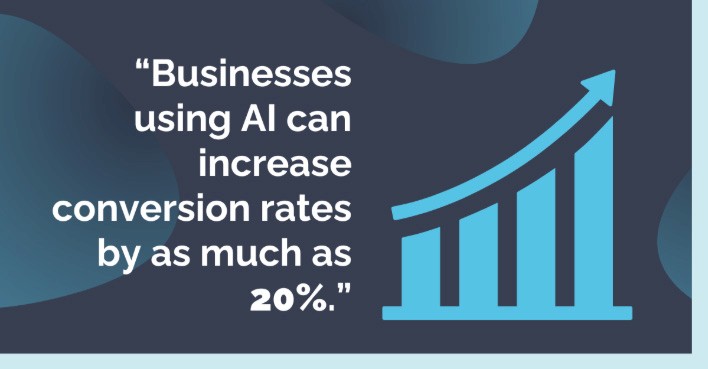
Beyond immediate gains, AI can enhance training and onboarding by providing actionable feedback and call analysis, helping new reps ramp up faster. Ultimately, organizations that embrace AI report 1.3 times higher revenue growth compared to those that don’t, officially cementing its role as a staple for modern sales teams everywhere.
Looking to the Future
AI is no longer a futuristic concept, but a practical tool reshaping sales today. From post-call analytics to workflow automation, AI empowers sales teams to perform at their best and close deals faster. Organizations that embrace AI today will gain a decisive edge in the competitive landscape of tomorrow. If you’re interested in seeing how CapOptix uses AI to help reps dominate their calls, contact us today to learn more.
Sources:
https://www.salesforce.com/news/stories/sales-ai-statistics-2024/
https://www.gong.io/blog/talk-to-listen-conversion-ratio